Registration open Free bootcamp, hackathon & conference — Africa's Hardware Revolution: From Spark to Ignition

Register free

Home / Community

Community

The largest student hardware tech community in South-East Nigeria.

Build nights, study groups, mentors, a component library and project teams — the infrastructure that turns an interest in hardware into the ability to build it.

What membership gets you

Eight things that only work with other people

You can learn to code alone. Hardware is harder to do that way — you need a bench, an oscilloscope, a spare part, and someone who has seen this failure before.

Weekly build nights

An open lab evening every week. Bring what you are working on, or pick up a community build and get started. Benches, tools and people who have already made your mistake.

Study groups

Small groups working through the same module together. Far more effective than grinding a datasheet alone at 2am.

Mentorship pairing

Every Builder is paired with someone two steps ahead of them — near enough to remember being stuck where you are.

Component library

Borrow the sensor, the analyser, the dev board. Not being able to afford a part should not be what stops a project.

Demo days

Every cohort ends by showing what it built to an audience that understands it and asks hard questions.

Hackathons

Fixed-length competitive builds against a brief. Fast, loud, and the quickest way to find out what you actually know.

Project teams

Multi-month teams on the systems listed under Projects, with defined roles and a real deadline.

Internships & placement

Introductions to partner companies, and support for members taking a capstone toward a product.

What the week looks like

Come for one evening and see

The rhythm is deliberately simple: one open lab evening a week that anyone can attend, study groups arranged around whichever modules are running, and project teams meeting on their own schedule.

During a bootcamp the pace changes — cohorts meet far more often for the length of the run.
Dates and venue are announced in the community WhatsApp group. Build-night times, cohort start dates and any change of venue all go out there first — join the group to get them.
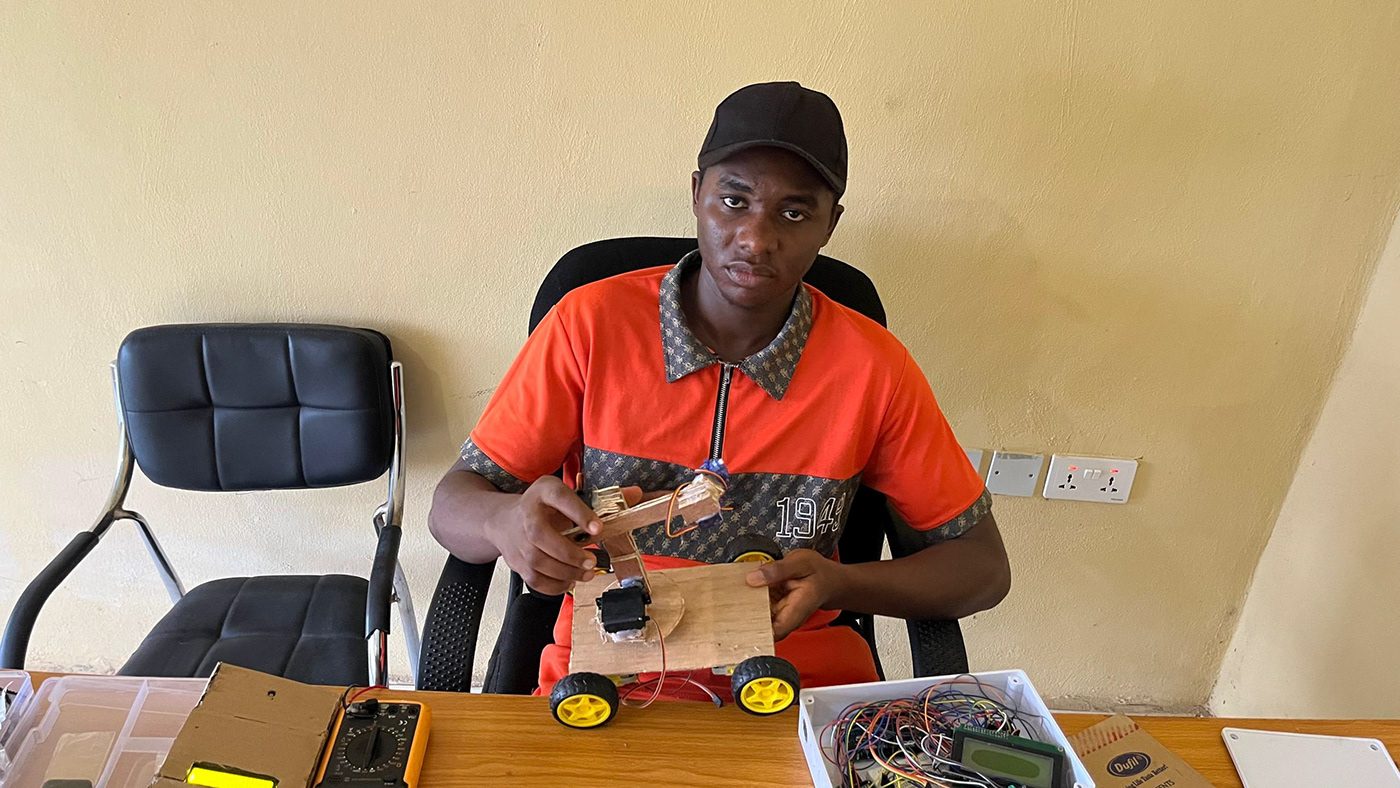
A member assembling the six-axis robotic arm at the bench
Getting started

Four steps, and the first one takes a minute

01

Join the channel

Open the WhatsApp community. Introduce yourself — what you study and what you want to build. That is the whole application.

02

Come to a build night

Turn up at the lab on the next open evening. Nothing is expected of you the first time except showing up.

03

Take the foundational tier

Join the next cohort, or work through Modules 01–04 with a study group if a cohort is not running.

04

Pick a direction

Choose a specialist track, join a project team, and start building something with your name on it.

How we behave

Code of conduct

A community only works as a place to be a beginner if beginners are safe in it. The rules are short and we enforce them.
  • No condescension. Everyone was a beginner recently. Answer the question that was asked.
  • Credit honestly. Name who did the work, cite the reference, disclose what was borrowed.
  • Share what you learn. If you solved it, write it down where the next person will find it.
  • Respect the equipment. Shared tools and borrowed parts come back, on time and working.
  • Zero tolerance for harassment. On any grounds, in the lab or the channel.
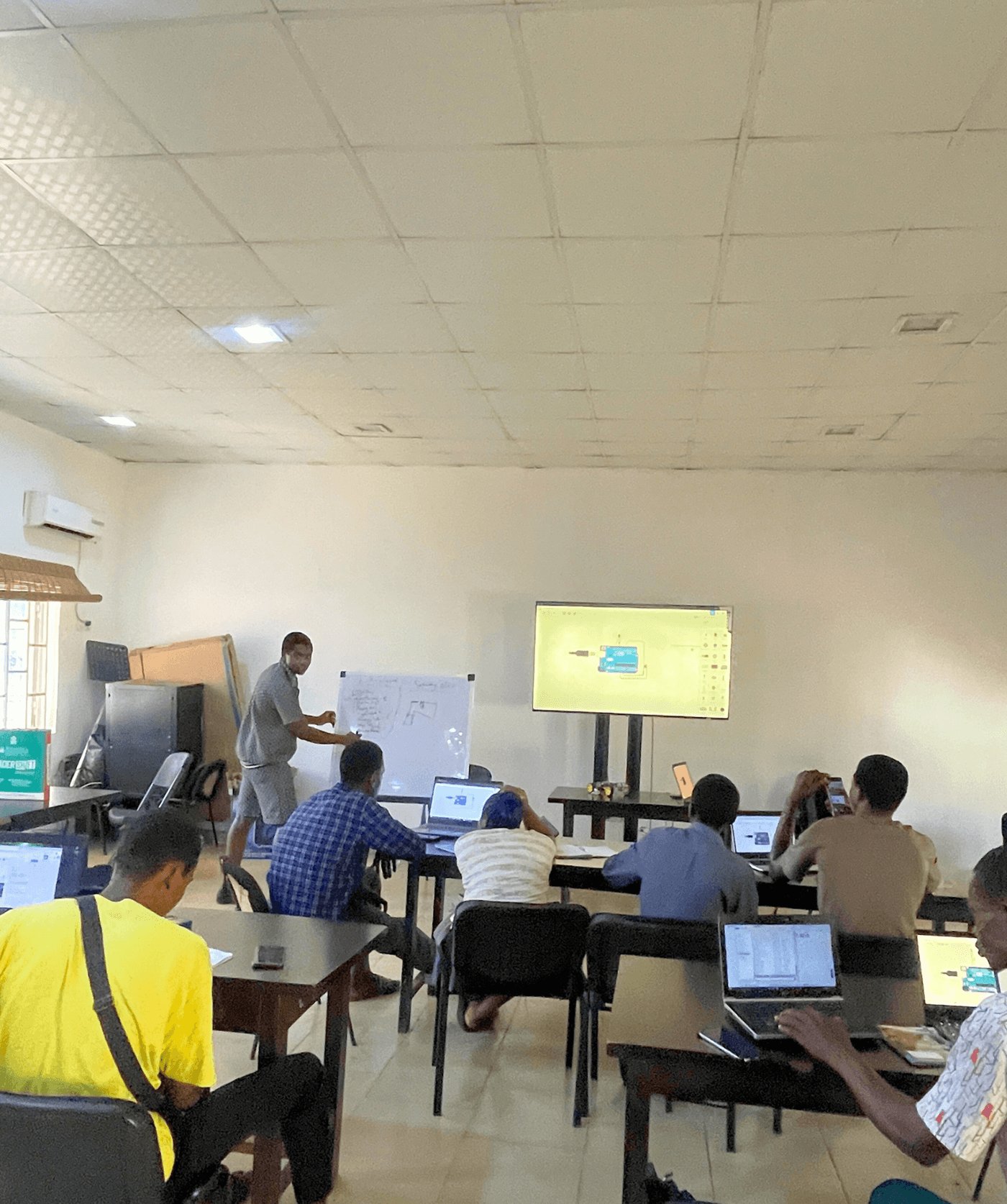
Members working together during a lab session
Questions

Things people ask before joining

Do I need any electronics experience to join?
No. The foundational tier assumes nothing — it starts at what current and voltage are and why a resistor matters. Most members arrive having never soldered anything.
Do I have to be a student at UNN?
No — and you do not have to be in Nigeria at all. The lab is at the University of Nigeria, Nsukka, and that is where the benches, build nights and bootcamps are, but membership is open to anyone, anywhere in the world. If you can get to Nsukka you can be a full member with lab access; if you cannot, you can still take part in the community channel, the study groups and remote project teams.

The free bootcamp is specific to UNN Nsukka for this first run. We are coming to other selected universities across South-East Nigeria next — at least one in each state.
Does it cost anything?
Associate and Builder membership are free, and bootcamp seats are free to members. The cost barrier is precisely the thing we exist to remove. Residents working on funded capstones are handled case by case.
What course do I need to be studying?
Any. We have members from electrical and electronic engineering, computer science, mechanical engineering, physics, and several from outside the sciences entirely. Hardware needs people who can design enclosures, write documentation and talk to users as much as it needs firmware engineers.
Do I need my own laptop or components?
It helps, but it is not a requirement. The community component library lends boards, sensors and tools to members, and lab machines are available during open hours.
How much time does it take?
A build night is one evening a week. A bootcamp cohort is considerably more intense over a fixed run of weeks. Project teams set their own pace around the deadline they have committed to.
Can my company partner or sponsor?
Yes — equipment, component budgets, internship places and project sponsorship are all useful to us. Write to victorogbonna313@gmail.com and say what you have in mind.
What happens after the capstone?
The strongest capstones go into incubation: we help with intellectual property, a pitch, pilot users and company formation. Both of our portfolio companies — Joint-Agent and CNG-Protect — started exactly this way.
Open intake

Introduce yourself in the channel

That is the entire joining process. Scan the code or follow the link, say what you study and what you would like to build.
QR code for the Ogbontor WhatsApp community