Robotics & Control
Kinematics, PID, motor drivers, chassis design and the arm rig.
Home / Programs
ProgramsA 19-module curriculum across five tiers, run as hands-on cohorts. Every tier ends with hardware you built yourself — not an exam.
From Spark to Ignition
Our next bootcamp is free and open to every student at the University of Nigeria, Nsukka — whatever you study, and whether or not you have ever touched a circuit. Come to learn, come to build something real, and come to be inspired.
A hackathon runs inside it — with prizes to be revealed — and a one-day hardware technology conference follows a few days later, where the winners are announced.
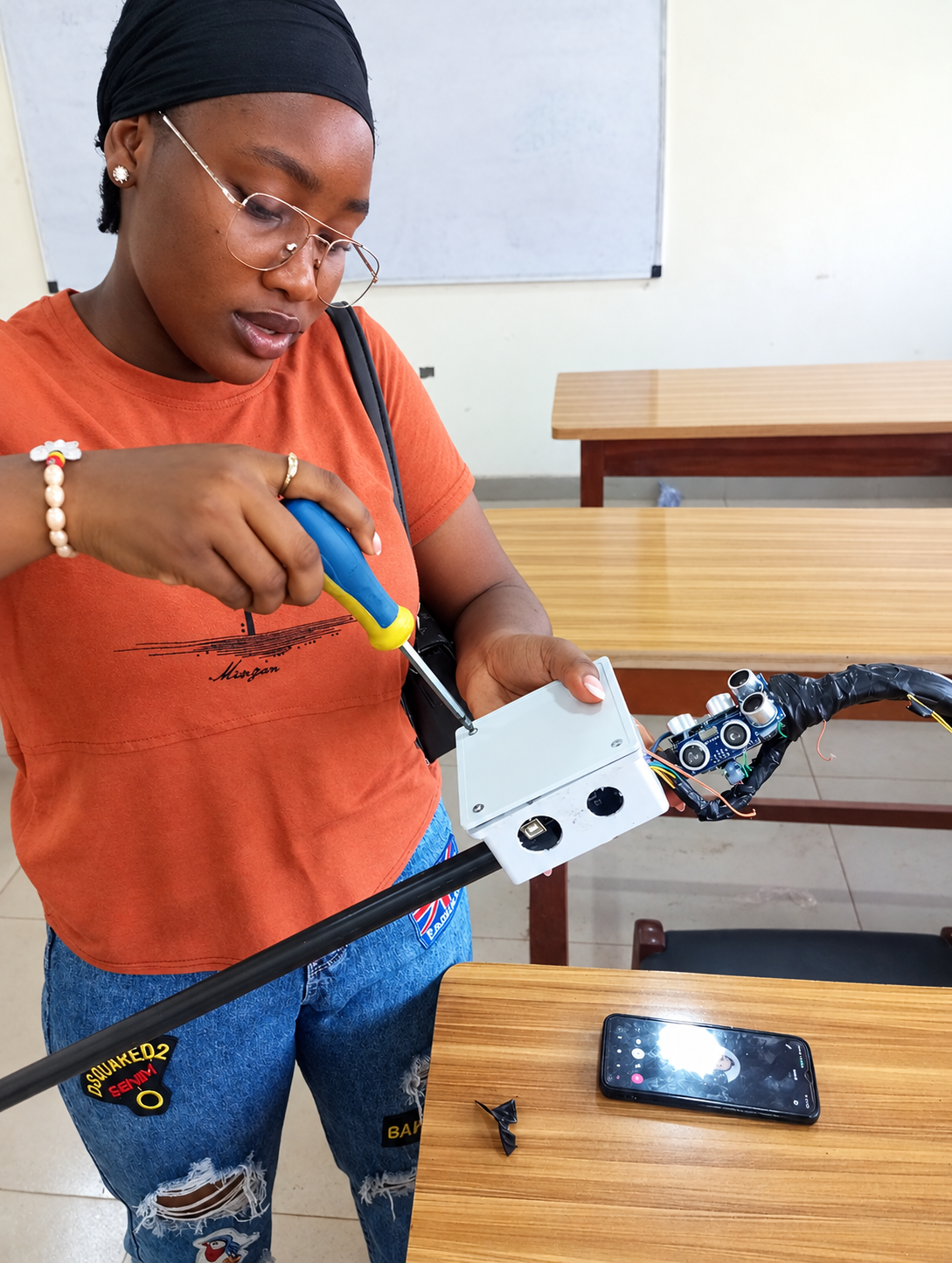
Bootcamps are how most members enter. A cohort moves through the foundational tier together over a fixed number of weeks, in the lab, with boards on the bench from day one.
You are not watching someone else build. You get a kit, a partner, a bug, and somebody experienced within arm's reach when you are stuck.
Tiers I through IV are taught modules. Tier V is the capstone — a real build, on a deadline, in front of real users.
Core principles — the vocabulary and habits everything else is built on.
Practical application — where members start shipping working hardware.
Specialised knowledge — the work that separates a hobbyist from an engineer.
Turning a breadboard into something you can hold, mount and manufacture.
Real builds, real deadlines, real users.
Once the foundational and intermediate tiers are behind you, you pick a direction and go deep with a project team working on it.
Kinematics, PID, motor drivers, chassis design and the arm rig.
MQTT, LoRa, GSM, power budgeting and devices that survive a field deployment.
Schematic capture, layout, DFM, bring-up and debugging a board that arrived dead.
Running inference on constrained silicon: quantisation, accelerators, camera pipelines.
Signing at the edge, key custody on device, and getting sensor data on-chain credibly.
Enclosures, tolerances, 3D printing and designing something you can actually manufacture.
We host SIWES and IT students from universities, polytechnics and colleges of education. A placement here is a bench, a project team and a supervisor — not a logbook you fill in at the end of the month.
Logbooks signed, ITF documentation handled, and a supervisor who can actually assess the engineering you did.
You join a project team with a deliverable and a deadline, and leave with something you can demonstrate at your defence.
Placement students sit the same tiers our members do — embedded systems, robotics, IoT, PCB design, CAD, edge AI, 3D printing and fabrication.
We are the first student-led hardware lab in South-East Nigeria to prototype in these areas. Alongside the technology programmes, placement students can work on the R&D lines we are building toward — long-horizon programmes where you would be joining early, on foundational work.
Winding, stator and rotor design, controller electronics and test rigs — the part of the electrification supply chain Nigeria currently imports wholesale.
Airframe prototyping, avionics and control systems, working toward manned aircraft manufacturing — the longest horizon on our roadmap, and the reason the curriculum goes as deep as it does.
From FPGA and CPU architecture through to silicon design — the foundation under every other programme we run.
Membership is about access and commitment, not fees. You move up by building, and every level above Associate is earned rather than bought.
Free
Anyone enrolled at any institution in South-East Nigeria.
Free · by cohort
Members who have cleared the foundational tier.
By application
Members carrying a capstone toward a real product.
You do not need prior electronics experience, a laptop of your own, or a particular course of study. You need to turn up.